
Rizwan Z. | Sep 16, 2026 | 6 min
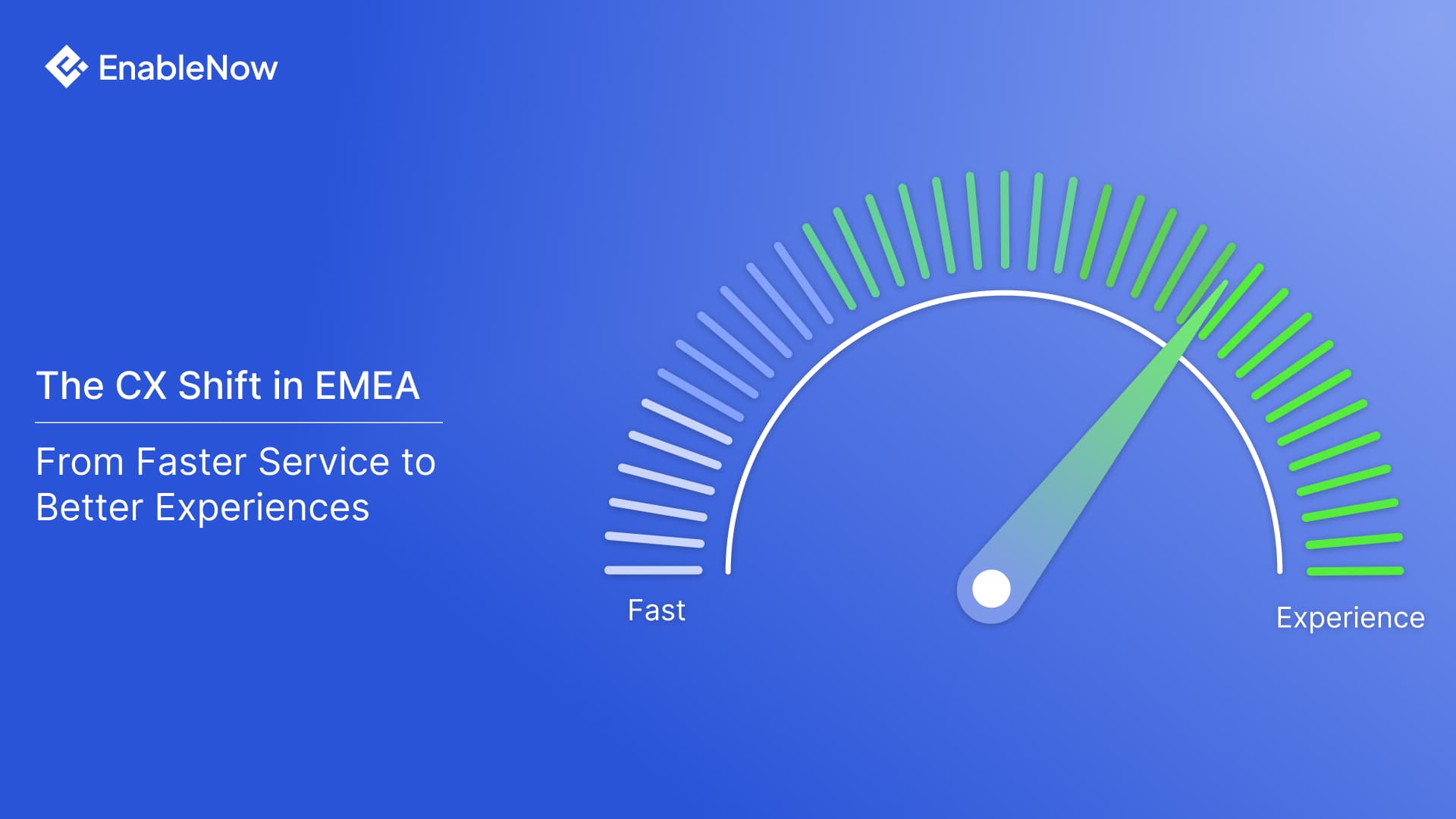
More than 27,000 customers took part in a new global study on AI and customer experience. Just over half of them, 14,000, were based across Europe and the Middle East, more customers than every other region in the study combined. ServiceNow partnered with the research firm ThoughtLab to survey customers, frontline service reps, and executives across 18 countries and eight industries for the report, called The CX Shift, and EMEA supplied the largest single-region share of respondents in all three groups: 51% of customers, 45% of executives, 44% of service reps, drawn from markets including the UK, Ireland, France, Germany, Austria, Italy, the Netherlands, Spain, Sweden, the UAE, and Saudi Arabia.
Whatever this research concludes, it is drawing that conclusion largely from EMEA. What it found should concern anyone running customer service across multiple European or Middle Eastern markets right now. AI has made service faster. It has not, in most organizations, made service feel more human, and the gap between the two is where customers are actually walking away.
Forty percent of customers say AI has already improved the speed and efficiency of their service experience, and 53% expect even more of that going forward. That part of the story is a genuine win. The problem sits right next to it: 48% of customers rate their overall service experience as average or worse, and the single biggest reason, named by half of all customers surveyed, is a lack of empathy.
A German consumer in the study captured the tension well: simple problems are fine for an AI chatbot, but anything complicated calls for a real person. That preference shows up in the numbers too. Seventy-five percent of customers say they try self-service before ever calling a rep, which tells you people aren't resistant to automation. But 46% say the chatbots they actually encounter don't understand their questions, and one German respondent described being routed through a chatbot even after it was clear the issue could only be solved by a human, calling the experience needlessly frustrating. That isn't a customer rejecting AI. That's a customer being denied a way out of a system that was never built to let them escalate.
The cost of getting this wrong isn't abstract. Forty-seven percent of customers across the study say they've switched to a competitor because of slow or inadequate service.
Ask customers what frustrates them most and ask executives to guess, and the two answers barely line up. Half of customers name lack of empathy as their top frustration. Less than a quarter of executives, 23%, guess the same thing. The disconnect repeats across nearly every category researchers tested: being transferred between departments, having to repeat an issue to multiple people, unclear explanations of policy. In every case, customers report it as a bigger problem than executives believe it to be.
That gap has real consequences for where investment goes. Only 16% of organizations report meaningful AI progress on building emotional connection with customers, despite it being one of the four things customers say they value most in a service interaction, alongside responsiveness, trustworthiness, and security. Executives are also backing the wrong channels. Eighty-seven percent of customers still rank phone calls among their preferred ways to reach a company, yet only 7% of executives plan to prioritize that channel over the next three years, even as they pour investment into digital surfaces customers haven't asked for.
Every organization in this study struggles with disconnected systems to some degree. Eighty percent of service reps have to log into three to five separate systems to handle a single customer issue, and only 45% of their time actually goes toward helping customers rather than administration and chasing information. For a business operating in one market, that's already a serious drag on service quality. For a business operating across the UK, the DACH region, the Nordics, Southern Europe, and the Gulf, each with its own legacy tooling, language requirements, and regulatory expectations, that same fragmentation compounds market by market. A rep in one country working from an incomplete customer view is a service problem. The same issue repeated across a dozen operating markets, each with slightly different systems bolted on over the years, becomes a structural one.
One global telecom operator featured in the study offers a sense of what fixing this looks like in practice: unifying 26 systems and roughly 8,800 separate data silos onto a single platform eliminated 500,000 customer calls and automated 90% of dispatch work. That isn't a story about a smarter chatbot. It's a story about removing the need for a customer to call in at all, because the underlying systems finally talked to each other.
The study includes examples from public and private sector organizations across EMEA putting this into practice. A UK government agency described using AI agent assistance to support the public around the clock and turn feedback into better service strategy. An Austrian telecoms operator deployed an AI coaching engine to upskill more than 8,000 field and call center agents, improving consistency and performance across the team rather than leaving it to individual variation. A French bank built AI-powered customer intelligence and conversational assistants to deliver tailored financial guidance and anticipate what clients would need next, rather than reacting after the fact.
What connects all three isn't the specific AI feature. It's that each organization treated their platform as connective infrastructure first, and layered AI on top of that foundation second. That ordering matters. Across the study, only 52% of executives say their organization has deployed an end-to-end platform supporting the full customer lifecycle, and only 34% report meaningful progress connecting people, data, and processes through unified, AI-enabled workflows. Most organizations are still trying to make AI do the work that a fragmented foundation was never built to support.
One useful framing from the study treats AI adoption in customer service as a staged progression rather than a single leap. Start with assisted AI, where the system captures and summarizes issues while a human still makes every call. Move to augmented AI, where human and AI agents work through resolution together. Only once that foundation is proven does autonomous AI, where AI handles routine cases end to end and people review the exceptions, actually make sense. Skipping straight to the last stage without earning the first two tends to produce exactly the brittle, over-automated experiences customers are already complaining about.
For organizations running service operations across multiple EMEA markets, each with its own regulatory backdrop and customer expectations, that staged approach isn't caution for its own sake. It's what makes a rollout survivable across a dozen markets instead of one. Getting the data foundation right, market by market, is slower than switching on a chatbot everywhere at once. It's also the only version of this that actually holds up once real customers start relying on it.

Rizwan Z. • Oct 06, 2026 • 6 min
Read full article→
Rizwan Z. • Sep 29, 2026 • 8 min
Read full article→

Rizwan Z. • Sep 09, 2026 • 8 min
Read full article→
Let EnableNow help you modernize workflows, strengthen performance, and unlock measurable value across your ServiceNow platform.
